
The Social Graph Is Dead
Facebook built its empire on a single idea: that mapping human relationships would be the most valuable thing in the history of commerce. The idea was right. The map was wrong.
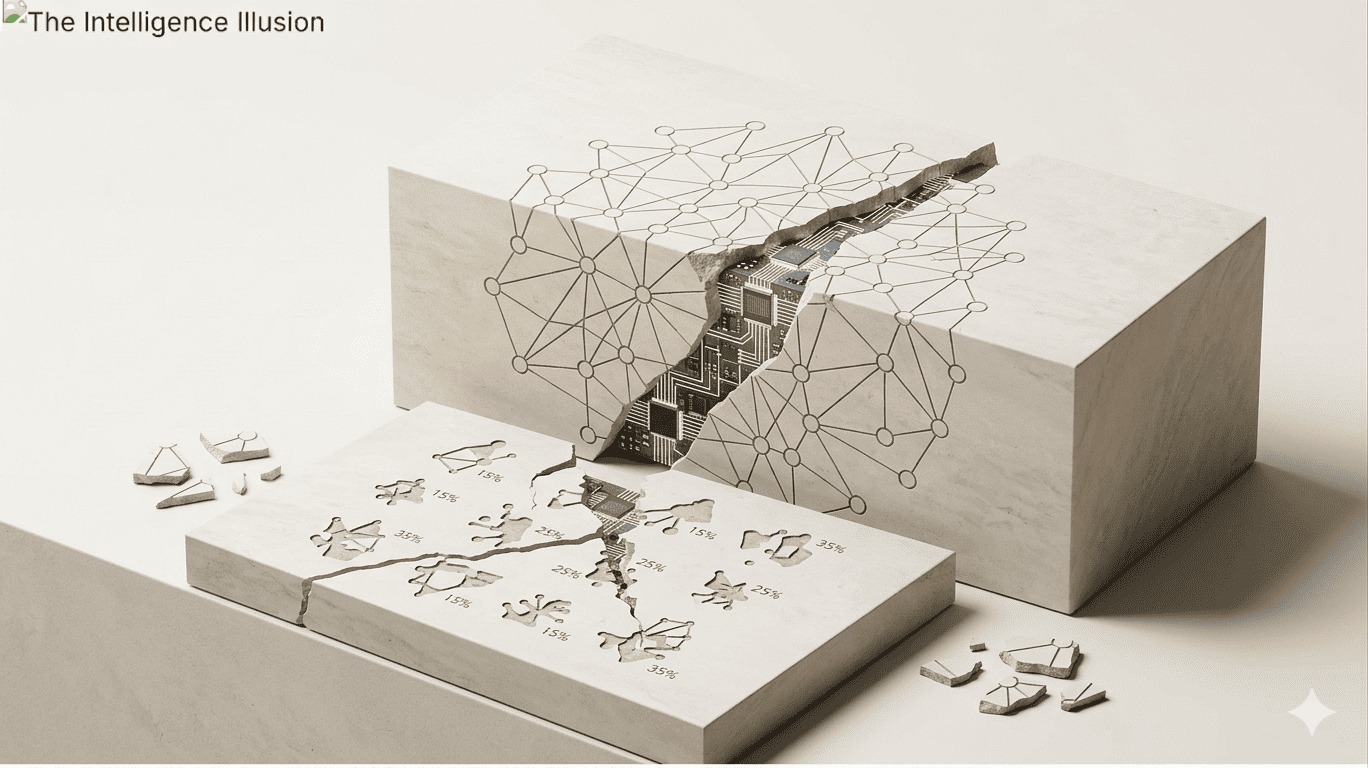
When Mark Zuckerberg testified before the Senate Commerce Committee in 2018 and was asked by Senator Orrin Hatch how Facebook makes money if its service is free, Zuckerberg replied, with an expression suggesting he was managing a kind of pedagogical fatigue: "Senator, we run ads." The moment became a meme, a symbol of the Senate's technological illiteracy. What was less remarked upon is that Zuckerberg's answer, while technically correct, missed the more interesting question Hatch had stumbled toward. Facebook doesn't make money primarily from ads. It makes money from the social graph — the map of human relationships that Facebook has spent twenty years building. The ads are how the map is monetized. The map is the product.
The social graph is the idea that your behavior, preferences, and vulnerabilities are most legibly encoded not in your demographic profile or your search history but in your relationships: who you are friends with, how you communicate with them, who you are close to and who you are not. Zuckerberg understood this with unusual clarity in 2004, when he was building what was still called TheFacebook in a Harvard dorm room. The value of the product was not the features — profiles and photo uploads and wall posts — but the relationship data those features generated. The social graph was infrastructure; everything else was a reason to use the infrastructure.
The social graph model dominated digital media for twenty years. It is now over. Not abandoned — Facebook's relationship graph still exists and still drives targeting revenue — but superseded as the organizational principle of the internet's social layer by something quite different, with quite different consequences.
The Golden Era and Its Logic
The social graph's golden era, running roughly from Facebook's 2006 open registration through the early 2010s, had a coherence that is easy to forget in retrospect. The model was simple: bring your real-world social network online, and the platform becomes a communication infrastructure for your actual life. The value was in breadth and representativeness — you needed everyone to be on the platform for it to mirror your actual social world, which is why Facebook's growth strategy was always about achieving universal adoption rather than cultivating a niche.
Twitter operated on a variation: not a mutual-friendship graph but a directed-follower graph, where you followed people who didn't necessarily follow you back, which enabled the platform to function as a public conversation space rather than a private social one. Instagram extended the model to photographs. LinkedIn applied it to professional relationships. The common premise across all of them was that the thing of value was the relationship data — that by mapping who people were connected to, you could infer almost everything else about them.
This premise was, as a business insight, correct. Advertisers paid a premium to reach users defined by their relationship networks because those networks were genuinely predictive: people whose friends had recently bought a stroller were more likely to be in the market for a stroller than people who had searched for "stroller" once. The behavioral inference that relationship data enabled was more powerful than the keyword-based targeting that had made Google's advertising business valuable. The social graph was not just another way to reach customers. It was a qualitatively different kind of attention.
But the social graph model had a structural tension built in from the beginning, and it manifested with increasing severity as the platforms aged. The early social graph was an accurate representation of genuine human relationships — people connected to people they actually knew, and the content they saw was content that people they actually knew had produced or shared. As the platforms grew and aged, both halves of this equation degraded.
The relationships became less accurate representations of genuine social bonds. On Facebook, a user with 800 "friends" has a graph that maps acquaintanceship, professional adjacency, school overlap, and distant family — a social topography that exists in real life but that no one experiences as their actual social world. The platform's effort to remain representative of real-world relationships was systematically undermined by the platform's growth incentives, which pushed users toward more connections rather than more accurate ones.
The content became less a product of genuine human relationship. As Facebook's algorithms optimized for engagement — for the time users spent on the platform and the actions they took — the content that performed best in the algorithm was frequently the content that generated the most emotional activation: outrage, anxiety, the specific social competitive instinct that Facebook's own researchers called "social comparison." The platform was using relationship data to deliver content that exploited the psychological vulnerabilities associated with social relationships, which is a different thing from connecting people to their actual social world.
The Interest Graph Coup
TikTok's arrival in the Western market, beginning around 2018 and accelerating dramatically through the pandemic years of 2020-2021, demonstrated that the social graph model's dominance was contingent rather than inevitable. The app had a simple and radical innovation: it showed you almost nothing from people you followed. It showed you whatever its algorithm predicted you would watch. The interest graph — your revealed preferences, inferred from what you watched, how long you watched it, when you rewatched it, where you scrolled away — replaced the social graph as the organizing principle. Your friends were irrelevant. What mattered was what you engaged with.
The results, measured in engagement, were dramatic. Users spent substantially more time on TikTok than on equivalent social platforms; the average daily usage figures TikTok reported during its growth period were nearly double comparable Instagram figures. The interest graph was, as an engagement mechanism, more powerful than the social graph, because it was freed from the constraint of your actual social world. Your friends post what they post; the algorithm gives you what it has learned you cannot stop watching.
The interest graph model spread backward through the existing platforms. Instagram's Reels feature, launched in 2020 in explicit response to TikTok's threat to Instagram's younger user base, shifted the app's recommendation logic toward interest-graph behavior: showing users content from accounts they did not follow, selected by engagement prediction, rather than content from accounts they did follow, selected by reverse-chronological order. Twitter/X's transition under Elon Musk's ownership included a shift toward algorithmic content recommendation rather than chronological timeline — the same direction, the same logic. Facebook's "Reels" rollout represented the same architectural concession.
The social graph had been supplanted not by a better version of itself but by a fundamentally different model — one in which the platform's relationship to users was not as a communication infrastructure for their actual social world, but as a content delivery system for their inferred psychological appetites.
What the Interest Graph Destroys
The transition from social graph to interest graph has consequences that are only beginning to be understood, and that are poorly captured by the current discourse about social media harms, which focuses primarily on individual psychological effects (depression, anxiety, body image) rather than on the structural transformation of the social space.
The social graph, for all its manipulation and engagement-optimization and ad targeting, was still organized around the premise that social media was a social space — a place where people communicated with people they had relationships with, in ways that (however distorted by algorithmic curation) were anchored in actual human community. When you saw something on Facebook in 2010 that upset you, you knew it came from your actual social world: a friend had shared it, an acquaintance had posted it, a family member had argued for it. The signal was real, even if the platform was shaping which signals you saw.
The interest graph platform has no such anchor. The content you see on TikTok or algorithmic Instagram is produced by people you have no relationship with, selected by a system that knows what you have engaged with in the past and is predicting what you will engage with next. There is no social meaning in the encounter — no relationship being maintained, no community being sustained, no actual communication occurring. There is just you, the algorithm, and an endless supply of content calibrated to your psychological profile.
The consequences for shared culture are serious. The social graph era, despite its many failures, maintained some of the functions of broadcast media: because everyone's social graph overlapped, and because content spread through the graph rather than being algorithmically individualized, a substantial portion of the population was exposed to the same stories at the same time. The interest graph breaks this. When the content you see is determined entirely by your individual engagement history, and your engagement history is different from everyone else's, the content landscape becomes radically fragmented. The concept of a "viral" piece of content becomes harder to define: viral to whom? In which interest community? Discovered by which algorithm?
This fragmentation has political consequences that are insufficiently theorized in the discourse about social media and democracy. The concern about "filter bubbles" — the idea that social media would expose people only to politically congenial views — was always somewhat overdrawn as a description of the social graph era, because social graphs span political communities and content spreads across partisan lines. The interest graph era makes filter bubble effects structurally more likely, because the algorithm responds to engagement and engagement is higher with emotionally charged content that is already consistent with your existing worldview. The partisan radicalization pipeline is not a bug of the interest graph model; it is a predictable product of optimizing for engagement in a politically polarized society.
For journalism and public discourse, the transition is existential in a way that hasn't been fully absorbed. The social graph era was already difficult for journalism: algorithmic curation of the Facebook news feed meant that publishers were dependent on Facebook's decisions about what to amplify, which introduced instability and perverse incentives. But the social graph era at least maintained the premise that news and information were competing for attention in a social space where people still had a relationship to shared factual reality. In the interest graph era, news competes with an infinite supply of entertainment content on the same feed, selected by the same engagement algorithm, with no structural preference for factual content over fiction, for context over provocation, for difficulty over ease.
The Coherence We Lost
There is a strain of media criticism that argues the social graph era was never the coherent public sphere its proponents claimed. The research on misinformation spread, on algorithmic amplification of outrage, on the specific psychological vulnerabilities that social media exploits, accumulates into a picture of a medium that was always structurally at odds with the quality of discourse. This critique has real force. The social graph era's problems were not incidental.
But the transition to the interest graph represents a structural retreat from the social entirely. The social graph, even manipulated, was at least a map of human connection — a space where people encountered their actual social world, where the platform mediated but did not replace social relationship. The interest graph has abandoned even the pretense. It is not a social network. It is an attention extraction system with social features appended as a retention mechanism.
The difference matters for how we understand what is being lost. The deterioration of shared culture, the fragmentation of political discourse, the collapse of common reference points that would permit even minimal cross-partisan communication — these are not simply the consequences of the internet disrupting old media hierarchies. They are the specific consequences of a transformation in the architecture of social media that replaced relationship-mediated communication with algorithm-mediated content delivery.
We are, in 2026, in the early stages of understanding what this transformation means. The interest graph platforms are larger and more engaged than the social graph platforms ever were. They are also, in the relevant sense, not social at all. They are content distribution systems that borrowed the language of social connection and the behavioral infrastructure of social relationship — the notification, the follower count, the like — to produce an experience that mimics sociality while systematically replacing it with something more profitable and more isolating. The map was the empire; the empire has eaten the territory it once described.