
The AI Provenance Crisis
AI-generated art is entering the auction market without disclosure, exposing $60B in market infrastructure to a trust failure it has no tools to manage.
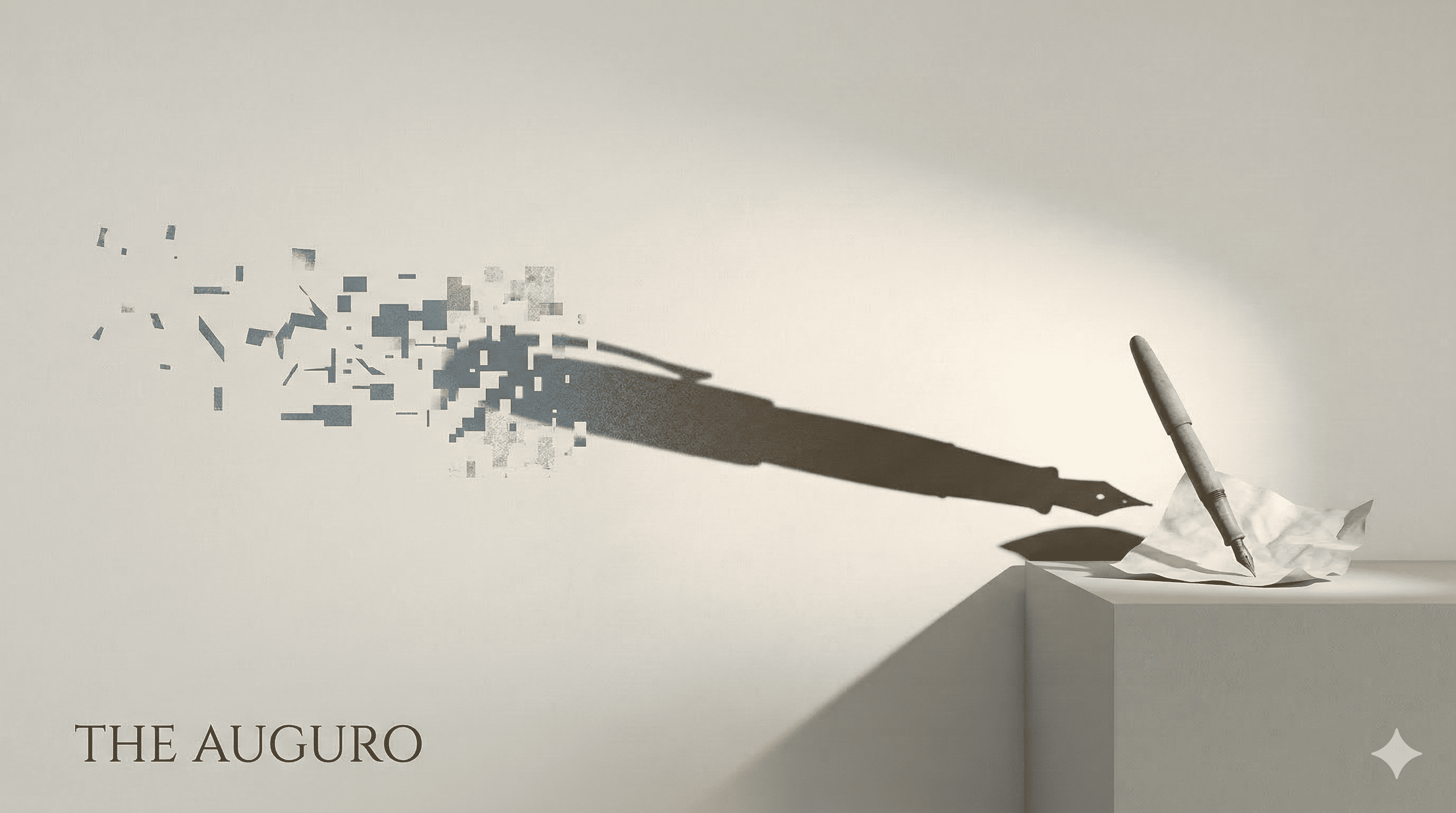
In November 2025, a works-on-paper lot at a mid-tier London auction house sold for £34,000. The buyer, a collector from Singapore, commissioned a provenance review six weeks later as part of a broader portfolio assessment. The review identified statistical signatures in the brushwork consistent with AI-assisted generation. The seller, when contacted, was not being deceptive in any deliberate sense — they had purchased the work from a gallery that had purchased it from an artist who used AI tools as part of their process and considered the work original. The question of what "original" means in that sentence has no current legal answer. The question of who bears the financial loss has no current market answer.
This is not an isolated incident. It is the leading edge of a structural problem that the art market, having ignored it for three years, is now beginning to confront with the urgency of institutions that have suddenly realized the foundation is cracked.
The Signal
Christie's and Sotheby's both announced, within six weeks of each other in early 2026, that they were developing AI-detection protocols for submitted works. Neither announcement specified a timeline, a methodology, or an enforcement mechanism. Both were notable primarily for what they acknowledged: that the problem is real, that the existing provenance infrastructure is inadequate to address it, and that the market does not currently have the tools to protect buyers.
The gap between the announcement and the solution is where the risk lives. The protocols being developed are, by the admission of people working on them, at least 18 months from deployment at scale. In that 18 months, the volume of AI-assisted and AI-generated work entering the market will continue to grow. The price points at which this work is circulating are moving upward. The exposure is compounding.
The Historical Context
Art market trust crises have a pattern. The forgery scandals of the 1980s — the Elmyr de Hory network, the Drewe-Myatt operation in the UK — revealed that provenance documentation was fabricatable and that authentication relied on expert opinion that could be purchased. The response took 15 years to produce functional institutional change: the Art Loss Register, digital provenance databases, due diligence requirements for major houses.
The current crisis differs from prior forgery crises in a structurally significant way. In the Drewe-Myatt case, the forgery was intentional and the forger knew they were creating fraudulent work. In the emerging AI provenance crisis, the chain of responsibility is genuinely unclear. An artist using generative AI as one tool among many may believe sincerely that they are creating original work. The gallery selling that work may have no reason to disclose what tools were used in its creation. The auction house may have no mechanism for detecting the distinction. The buyer has no information. None of these parties is being deceptive in the traditional sense — and yet the buyer may have purchased something fundamentally different from what they believed they were purchasing.
This distributed non-deception is harder to regulate than intentional fraud. It requires not a law enforcement response but an infrastructure response — new disclosure norms, new detection capabilities, new legal frameworks for what "authorship" means when a human and a generative system collaborate.
The Mechanism
The AI provenance crisis is being driven by three converging forces.
First, generative AI tools have become standard components of studio practice for a significant fraction of working artists. This is not a marginal or underground phenomenon — it is mainstream. The artists using these tools range from those who use AI to generate reference images they then paint from, to those who use AI to suggest compositional options, to those whose finished works are directly AI-generated with minimal post-processing. The spectrum is continuous and the endpoints are not clearly distinguishable from the outside.
Second, the art market's valuation infrastructure is built on the concept of unique human authorship. The premium paid for a painting over a reproduction, for an original over a print, rests on a set of assumptions about the relationship between human creative labor and the resulting object. Generative AI does not destroy this relationship — it complicates it in ways the market's pricing mechanisms cannot currently handle.
Third, the legal framework governing authorship and disclosure in the art market has not kept pace with the technology. In most jurisdictions, there is no requirement to disclose AI involvement in the creation of a work being sold at auction. The existing fraud law frameworks were written for a world where the distinction between human-made and machine-made was unambiguous.
Second-Order Effects
The primary exposure is financial: buyers who have purchased AI-assisted or AI-generated work under the belief that they were purchasing human-made work may have paid a premium that is not justified under their own valuation model. The scale of this exposure, across the secondary market globally, is not calculable with current information — but the volume of AI-assisted work that has entered the market since 2022 is large enough that the exposure is significant.
The secondary exposure is institutional: the major auction houses have staked their commercial viability on being trust intermediaries. Their fees — which run to 25-30% of hammer price at major houses — are justified by the due diligence and authentication infrastructure they provide. If that infrastructure is revealed to be inadequate for the current environment, the justification for those fees weakens. This is an existential risk, not a reputational one.
The tertiary exposure is cultural: the art market's legitimacy depends on a shared fiction about the value of unique human creative labor. If that fiction becomes obviously unsustainable, the entire apparatus of contemporary art valuation — not just auction houses, but galleries, art fairs, museum acquisition policies, and the pricing of living artists — is subject to renegotiation.
What to Watch
Detection technology deployment: The first credible AI-detection protocol adopted by a major auction house will be the signal that the market has begun to price in the risk. Watch Christie's and Sotheby's announcements over the next 18 months.
Legal precedent: The first successful lawsuit by a buyer against a seller for non-disclosure of AI involvement in a sold work will establish the liability framework. Watch UK and New York courts, where art market litigation concentrates.
Disclosure norm formation: If any major living artist publicly adopts a voluntary AI disclosure standard, it will accelerate norm formation across the market. Watch the artists in the $1M+ price range who have the most to lose from trust erosion.
Price divergence: If the secondary market begins pricing verified human-made works at a consistent premium over works without AI verification, the market has internalized the risk. Watch auction results for comparable works with and without digital provenance documentation.
The art market has survived every prior trust crisis by adapting its infrastructure rather than its fundamental model. Whether that is possible here depends on whether the infrastructure can be built fast enough to stay ahead of the exposure. The current gap suggests it cannot — which means the crisis will deepen before the adaptation arrives.