
Auction Houses Are Certifying AI Art — and the Legitimacy Crisis Is Just Beginning
Christie's 'Augmented Intelligence' sale and the 6,000-artist petition against it reveal something the art market has not confronted: who gets to define what counts as a work of art when authorship becomes contested at the institutional level.
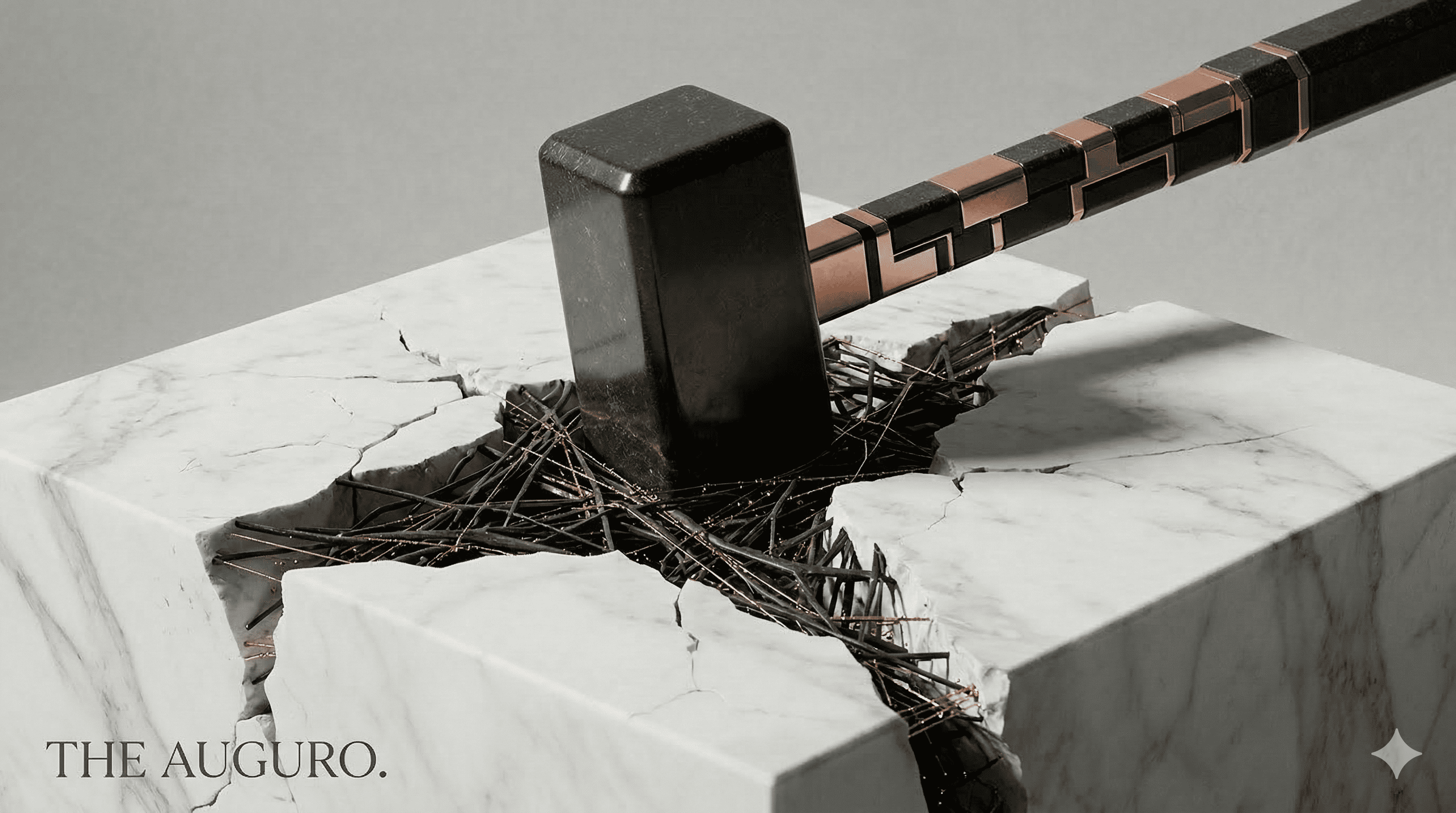
In early 2025, Christie's held its first dedicated AI art auction — "Augmented Intelligence" — featuring works produced with or by generative AI systems. It drew hundreds of thousands of dollars in bids. Simultaneously, a petition signed by more than 6,000 artists demanded the sale be cancelled, citing unconsented use of human artists' work as training data. Christie's proceeded. The market was enthusiastic. The artists were furious.
The coincidence of these two facts is not a contradiction to be resolved. It is the signal.
The Signal
The Artprice Annual Report released in March 2026 documented 12% growth in global art auction turnover in 2025, with 1.28 million works offered — the highest volume in the market's history. The same week, Artprice announced a partnership with Perplexity AI to provide market intelligence subscriptions using AI-synthesized analysis. The auction houses are not cautiously dipping a toe into AI. They are reorganizing their entire operating infrastructure around it, from the works they sell to the tools they use to analyze what those works are worth.
The petition's 6,000 signatories are not a fringe reaction. They include major gallery-represented artists, museum-collected practitioners, and institutions with genuine market standing. Their grievance is specific: the generative AI systems producing the sold works were trained on human-created art without compensation or consent. When Christie's sells an AI-generated piece, it is — in the signatories' framing — monetizing the unconsented extraction of human labor. The legitimacy challenge is not aesthetic. It is economic and ethical.
The Historical Context
The auction house has always been more than a market mechanism. It is a legitimating institution: by accepting a work for sale, by providing provenance, by setting a hammer price, Christie's and its peers confer cultural validity. Warhol was not collectible until the auction houses treated him as collectible. The relationship between market validation and artistic legitimacy is circular in ways that art critics have long resented and artists have long understood.
That circularity is precisely what makes the AI auction crisis structural rather than aesthetic. If auction houses certify AI-generated works — by accepting them for consignment, by describing them in catalog language that treats them as equivalent to human-authored works, by establishing price records that become future valuation benchmarks — they are not merely entering a new category. They are redefining the criteria for inclusion in the category they have always governed.
The previous legitimacy disruption on comparable scale was the street art moment — Banksy, Basquiat, the transition of graffiti-derived work into auction rooms in the 2000s. That transition was contested, but the contention was about taste and institutional authority, not about authorship. Nobody argued that Banksy had not made the works. The AI dispute is categorically different: the authorship question is genuinely unresolved, and the auction house's acceptance of a work implies a position on that resolution.
The Mechanism
The legitimacy crisis is operating through three reinforcing channels.
Provenance infrastructure failure: Art's value depends on traceable history — who made it, when, under what circumstances, who has owned it. AI-generated works have no comparable provenance. The training data is undisclosed, the generation process is probabilistic, the "artist" may be a prompt engineer with no traditional artistic practice. The auction house's standard provenance documentation cannot meaningfully capture this. The gap between what provenance documentation says and what it needs to say for AI works is being papered over, not resolved.
Insurance and authentication breakdown: Art insurers price works based on authenticity and provenance verification. Art authenticators develop expertise in specific artists' hands, materials, and periods. Neither infrastructure has the tools to assess AI-generated works. The result is that the fastest-growing segment of the auction market is also the least insurable and the least authenticatable — a combination that creates systematic long-term risk for collectors who are not currently pricing it.
Labor organization emergence: The petition campaign is not just protest. It is the beginning of an organizational form — artists as a collective with economic grievances against a specific industry practice — that the art world has not historically supported. The individualist mythology of artistic genius has made collective action culturally unappealing; the AI dispute is forcing a reconsideration because the grievance is not aesthetic but structural. If the petition converts into legal collective action or formal guild filing, the art market will face the first serious labor organizing challenge in its modern history.
Second-Order Effects
The downstream consequence that nobody is currently tracking: disclosure standards will become the new battleground, and their emergence will restructure the entire secondary market. The pressure on auction houses to develop formal AI disclosure requirements — which work, in which catalog, lists AI involvement and to what degree — is building from multiple directions simultaneously: artists, insurers, institutional collectors with ethical mandates, and regulatory bodies.
When disclosure standards arrive, they will function as provenance infrastructure for AI-era work. But they will also retroactively complicate the works sold without adequate disclosure in 2024 and 2025. Early collectors who paid record prices for AI works with incomplete provenance will face uncertain resale markets. The valuation premium paid for novelty will collide with the discount applied for incomplete documentation.
The national museum question is the most consequential second-order signal. MoMA, Tate, Guggenheim, and the Louvre have not published acquisition policies for AI-generated works. When they do — and the pressure to do so is building — they will be making statements about authorship that will have legal, market, and critical consequences far beyond their own collections.
What to Watch
Christie's and Sotheby's disclosure policies: Whether either house announces formal AI disclosure requirements for consigned works before the end of 2026 will establish whether the industry is self-regulating or waiting for external mandate. Absence of action by year-end will accelerate regulatory and legal pressure.
National museum acquisition policies: The first major museum to publish a formal AI acquisition policy will set the critical precedent. Watch for board meeting agendas and trustee statements at Tate, MoMA, and the Guggenheim for signals of when this policy work is underway.
Authors Guild "Human Authored" analog in visual arts: Watch for whether any visual arts professional organization launches a certification equivalent to the Authors Guild's "Human Authored" label — and whether major galleries require it for represented artists' works.