
The Museum Is Not Neutral
For two centuries, Western museums presented themselves as stewards of humanity's heritage. The reckoning now underway reveals how selective that humanity always was.
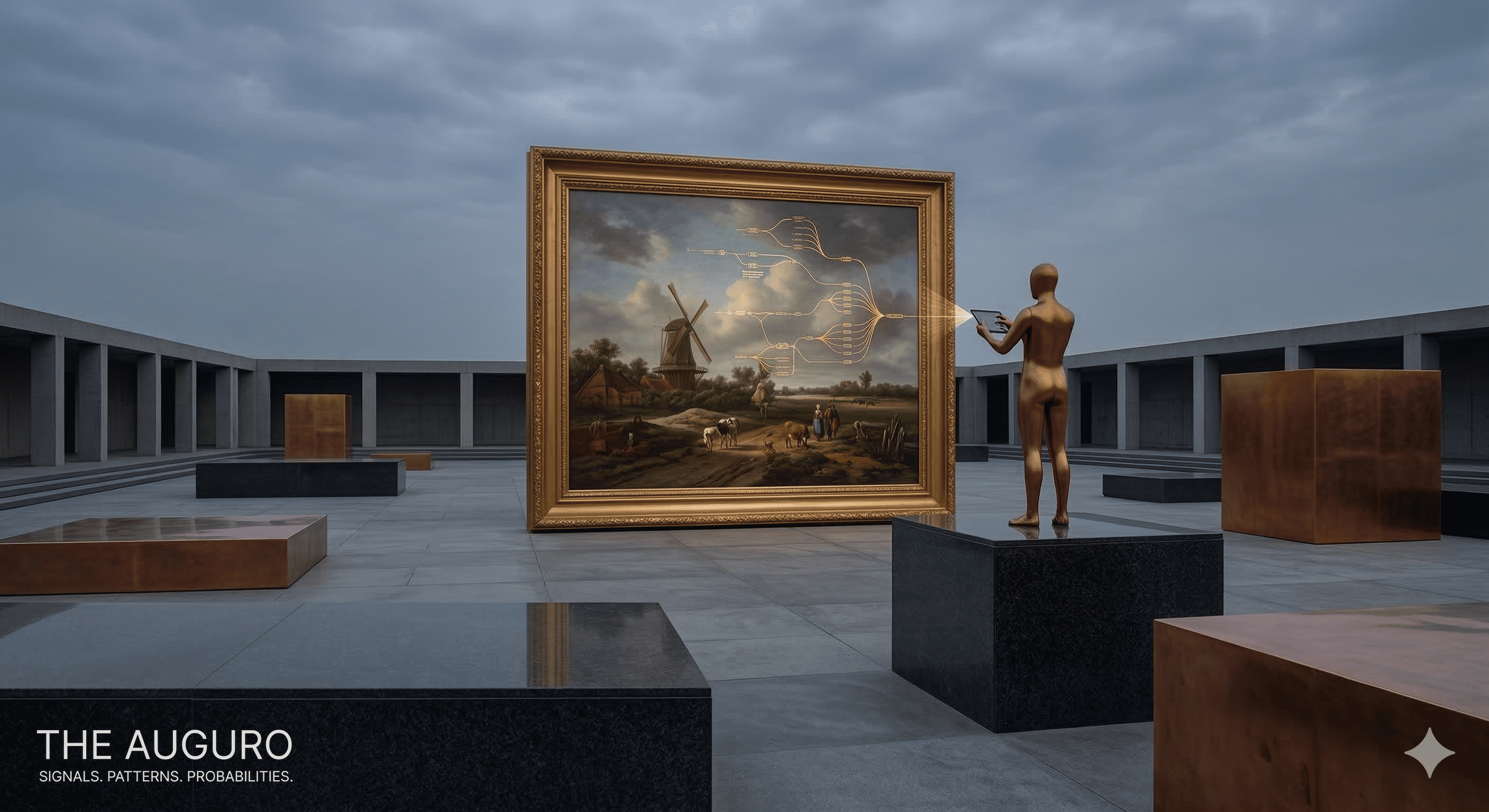
The British Museum contains approximately eight million objects. It displays perhaps one percent of them at any given time. The rest sit in climate-controlled storage, catalogued and preserved by a staff of specialists, owned by the British public in whose name the museum claims to hold them. Among those eight million objects are the Benin Bronzes — approximately nine hundred of them, taken from the Kingdom of Benin by British forces in 1897 during a punitive expedition that burned the royal palace, killed hundreds, and removed from the kingdom essentially its entire artistic heritage.
Nigeria has been asking for them back for decades. The British Museum has said no, citing legislation that prohibits it from deaccessioning objects from its collection. The legislation has been amended to allow returns in cases of theft or spoliation; the British Museum has argued that the Benin bronzes do not qualify. The conversation has been going on, in various forms, since at least 1977, when General Olusegun Obasanjo raised the issue at a UNESCO conference.
This story is, in miniature, the story of the Western museum: an institution that accumulated objects from the entire world through a combination of purchase, gift, excavation, and outright seizure, that spent the better part of two centuries telling itself and its visitors that this accumulation served a universal human good, and that is now — slowly, partially, and with considerable institutional resistance — being asked to reckon with what that universal actually excluded.
The modern encyclopedic museum was a product of the Enlightenment, and it carried the Enlightenment's contradictions built into its foundations. The founding premise was genuinely inspiring: that the artifacts of all human civilizations deserved to be preserved, studied, and made available to any person capable of learning from them. The British Museum opened in 1753, the Louvre in 1793, the Smithsonian in 1846 — each claiming to be a repository not of national glory but of human knowledge.
The problem was that this universalism was exercised through the particular mechanism of European imperial power. Objects arrived at these museums through trade routes that were structured by colonial inequality, through excavations conducted under concession agreements imposed on colonized governments, through direct seizure during military operations, and through the more diffuse pressure of economic relationships in which "selling" an artifact to a European buyer was not always the transaction it appeared to be.
The curators and directors of these institutions were not, for the most part, cynical. Many genuinely believed that they were rescuing objects from neglect, political instability, or the indifference of local populations who had not yet developed the historical consciousness to value their own heritage. This belief was often wrong on the facts — many of the objects taken were actively used, venerated, and cared for by the communities they were removed from — and it was in any case a belief that conveniently aligned the interests of universal culture with the interests of European states and their imperial projects.
Metaculus maintains a long-run forecast on whether the British Museum will return more than 100 objects to their countries of origin before 2030. As of February 2026, it sits at 34 percent. Given the legislative obstacles and the institutional culture of the museum, this is probably slightly optimistic. But the direction of travel is real: returns have been accelerating across European institutions. Germany returned more than a thousand Benin Bronzes to Nigeria in 2022. France has committed to systematic repatriation of objects taken during the colonial period. The Smithsonian has repatriated thousands of Native American remains and objects under the Native American Graves Protection and Repatriation Act.
The philosophical debate about repatriation is more complex than the political debate typically acknowledges, and it deserves engagement on its merits rather than dismissal as either Western imperialism or anti-Western virtue signaling.
The strongest argument for retention is the universalist one: that great art and significant cultural artifacts belong, in some meaningful sense, to all of humanity, and that their concentration in well-funded, well-staffed institutions that can preserve them, study them, and make them available to international audiences serves a genuine human good. The Elgin Marbles — another name for the Parthenon sculptures held at the British Museum — are seen by millions of visitors annually. The Acropolis Museum in Athens, opened in 2009, was built specifically to hold the sculptures if they are returned; it is well-funded and professionally run. But the British Museum's annual visitorship still dwarfs what the Acropolis Museum receives.
The universalist argument is weakened, however, by its selective application. The encyclopedic museums do not apply universalist principles symmetrically. They do not argue that American art should be housed in London because more visitors would see it there, or that Chinese bronzes currently in private collections in Hong Kong should be centralized in Paris for the benefit of humanity. The universalism is exercised primarily in the direction of retaining objects that arrived in European institutions through the mechanisms of colonial power. This asymmetry is not incidental to the argument — it reveals the argument to be less about universal access than about institutional inertia and national interest dressed in philosophical clothing.
The strongest argument for repatriation is not purely about justice to the source communities, though that consideration is real and weighty. It is about what happens to objects when they are removed from the context of their creation and use. The Benin Bronzes were not merely decorative — they were part of a living system of royal commemoration and political authority. Removed from that system, displayed in a glass case in Bloomsbury, they become beautiful artifacts of a lost civilization rather than, as they are, objects from a living culture that continues to exist and that has maintained an active relationship with them for centuries. The museum that presents them as relics has misrepresented them as fundamentally as if it had mislabeled their date or material.
The current wave of museum reckoning in the United States has taken a different form than the European debate about colonial acquisition. American museums have been primarily challenged on questions of donor ethics, leadership demographics, and the representation of marginalized communities in permanent collections and curatorial staff — challenges that are related to the colonial acquisition debate but distinct from it.
The resignations and board restructurings at the Whitney, the Guggenheim, and the Metropolitan over the past five years reflect a genuine shift in the power dynamics of the art world, as artists and critics who were previously excluded from the institutions that defined artistic value have found new leverage through social media, collective action, and the philanthropic anxieties of major donors. Whether this shift represents a lasting transformation of these institutions or a temporary accommodation of external pressure is an open question. The Smithsonian's National Museum of the American Indian, opened in 2004, is probably the best evidence that institutional transformation is possible — it was designed in collaboration with Native American communities, staffed primarily by Native Americans, and organized around Native American frameworks of meaning rather than Western museological conventions.
It is also, by most visitor metrics, less visited than the Air and Space Museum next door. The universalist argument — that access justifies retention — turns out to be in significant tension with the empirical reality that most museum visitors do not seek out the most challenging representations of human diversity. They go to see the dinosaurs, the gems, the Impressionists. The museums that have done the most to represent colonialism honestly tend to attract fewer visitors, not more.
This is not an argument against honest representation. It is an observation that the universalist mission of the museum and the commercial reality of museum attendance pull in different directions, and that institutions navigating that tension will continue to do so imperfectly regardless of whether the objects they hold were acquired ethically.
Leila Farahani is a contributing writer at The Auguro covering culture, institutions, and the politics of representation.