
The Future of Architecture
AI is redesigning construction. Ancient materials are being reborn through biotechnology. And the buildings of tomorrow will think, breathe, and adapt in ways we are only beginning to imagine. Welcome to the era of the intelligent built environment.
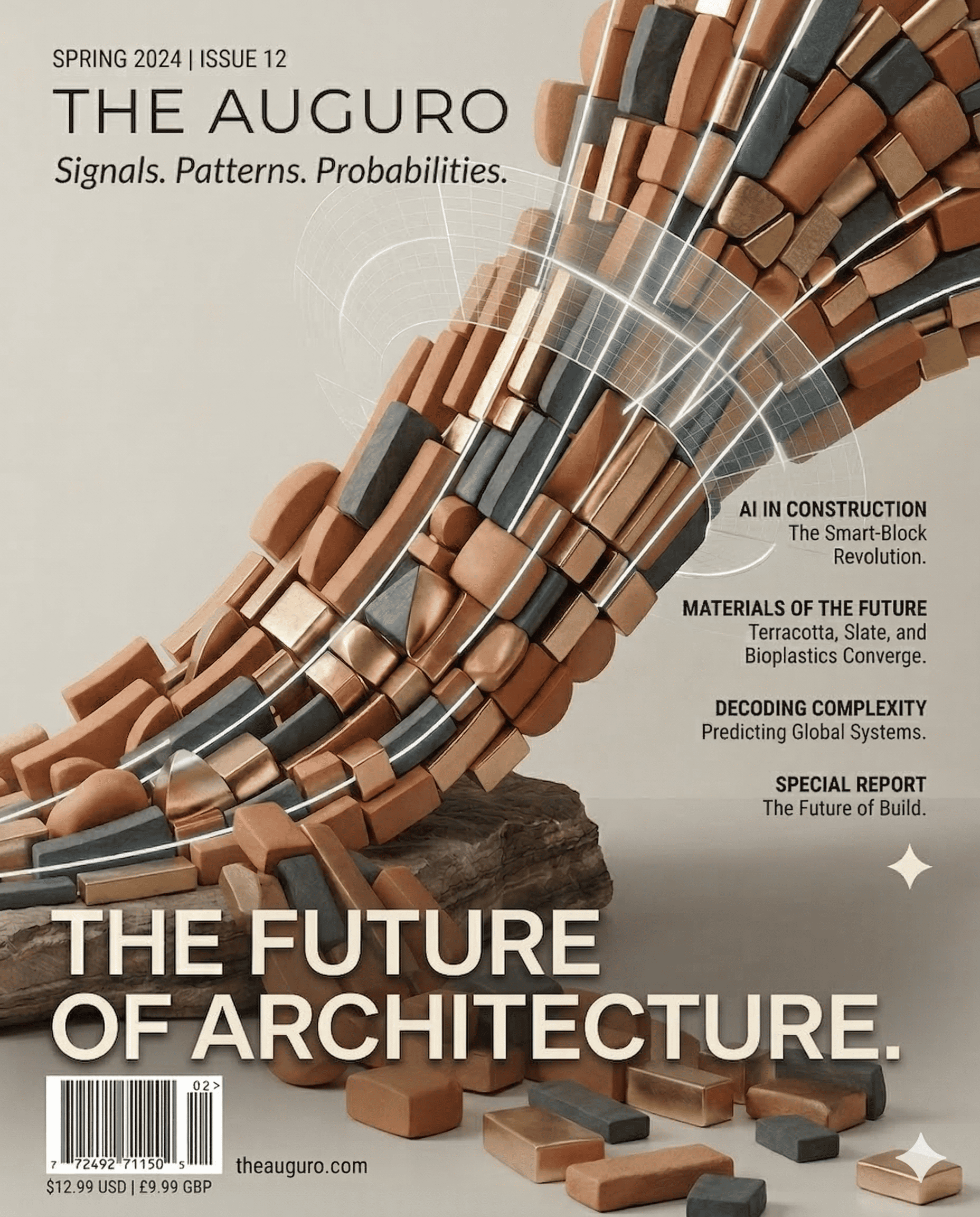
There is a sculpture in the lobby of a research institute in Zurich — a sweeping arc of terracotta bricks, slate tiles, and copper-hued composite panels, arranged not by a stonemason but by a robotic arm guided by a generative algorithm. It took eleven hours to build. It weighs four hundred kilograms. It should not be structurally possible. Every material in it has been used in construction for at least five hundred years. And yet no human hand, working without computational assistance, could have assembled it into the cantilever it achieves, because no human mind could have held all the load calculations, stress tolerances, and material behaviors in simultaneous attention long enough to solve for the form.
This sculpture is not art. It is a proof of concept. And what it proves — quietly, without announcement — is that the future of architecture has already arrived. It arrived in a research lab. It arrived in the form of a beautiful, impossible object. And it is now making its way, with increasing speed, into the buildings where the rest of us will live and work and age.
The Rupture We Keep Postponing
Architecture has always been a lagging technology. The materials and methods that shape most of the world's buildings — concrete, steel, timber framing, glass curtain walls — were largely mature by the mid-twentieth century. The computational revolution that transformed every other design field, from industrial design to aerospace engineering to pharmaceutical research, touched architecture at its edges: we got better rendering software, more sophisticated structural analysis tools, parametric modeling that could generate complex geometries from simple rules. But the core act of construction — assembling physical materials into physical structures using human labor and conventional machinery — remained stubbornly analog.
This is changing. Not gradually, in the way that architectural technology has always slowly evolved, but in the discontinuous, system-reshaping way that characterizes genuine technological rupture. The confluence of three distinct forces — artificial intelligence applied to design and construction, a new generation of engineered and biologically derived materials, and the emergence of buildings as data-generating computational systems — is producing something that deserves a name other than "architecture." We do not yet have the name. But we are beginning to understand the thing.
AI in Construction: Beyond the Rendering Farm
The popular image of AI in architecture is the rendering farm: give a generative model a text prompt, receive a photorealistic image of a building you could never actually build. This is real, and it is useful for ideation, and it is also largely beside the point. The more consequential applications of artificial intelligence in construction are happening at a level of granularity that never makes it into architecture reviews.
Consider structural optimization. Traditional structural engineering is a deeply conservative discipline, by necessity. Engineers design buildings to tolerate loads far greater than they are likely to encounter, using safety factors that encode decades of accumulated hard experience with materials that fail in unpredictable ways. This conservatism is rational given the costs of error. But it is also enormously expensive in material terms: a significant fraction of the concrete and steel in most buildings is there not because the structure needs it, but because the engineer cannot be confident enough in the calculation to leave it out.
Machine learning models trained on the structural behavior of thousands of existing buildings are now beginning to produce designs that use material only where it is mechanically necessary — designs that look, to the untrained eye, like biological forms, like the cross-sections of bones or the branching architectures of trees, because evolution has been running the same optimization process in organic materials for hundreds of millions of years and has converged on many of the same solutions. The structural members in these AI-optimized buildings are thinner where the loads are lighter, denser where the stress concentrates, curved in ways that distribute force rather than resist it. They use forty percent less concrete than conventional designs with equivalent structural performance.
The same principle is being applied to energy systems, construction sequencing, supply chain logistics, and building maintenance. A construction AI deployed on a major hospital project in Singapore last year predicted seventeen potential schedule conflicts and four safety risks before ground was broken, based on analysis of the project documentation — a task that would have required weeks of expert review and would still have missed some of what the model found. Another system, installed in a commercial tower in Chicago, has reduced the building's energy consumption by twenty-three percent not by replacing any of its mechanical systems but by continuously adjusting temperature, ventilation, and lighting based on real-time occupancy patterns and weather data, learning which parts of the building are used when and optimizing the systems accordingly.
These are not dramatic interventions. They do not produce buildings that look different from the outside. But they represent a fundamental shift in how intelligence is distributed through the design and construction process — from a small number of expensive experts making large decisions to a continuous, granular, machine-assisted process of optimization that permeates every level of the project.
The Material Convergence
Materials science has always been the hidden engine of architectural possibility. The invention of Portland cement in the nineteenth century enabled the construction of the modern city. The development of high-strength steel made the skyscraper possible. Float glass technology, which made large flat panes of uniform thickness economically viable, defined the aesthetic of the twentieth-century office building. Every major shift in what buildings look like and how they perform has been preceded, often by decades, by a shift in what materials are available and what they can do.
We are in the early stages of the next such shift, and it is more complex than any previous one because it is not the emergence of a single new material but the convergence of several distinct material revolutions happening simultaneously.
Terracotta reborn. Fired clay is one of humanity's oldest building materials — it has been in continuous use for at least ten thousand years. The terracotta facades of nineteenth-century commercial buildings and the tile roofs of the Mediterranean represent its traditional architectural expressions. What is happening to terracotta now is something different: computational design tools are allowing manufacturers to produce terracotta units in geometries that were previously impossible to fire consistently, creating facade systems that function as dynamic brise-soleil, managing solar gain and natural ventilation with a precision that glass curtain walls cannot match. Several major projects in southern Europe and the Middle East have deployed terracotta facade systems that reduce cooling loads by thirty to forty percent compared to glass alternatives — not because the material has changed, but because computation has unlocked geometries that ancient craftspeople could not have produced at scale.
Slate as structural data. Natural stone has largely been relegated to cladding — a surface material applied to structural frames of steel or concrete. But a new generation of quarrying and cutting technologies, combined with digital analysis of stone's variable structural properties, is beginning to restore load-bearing stone to serious architectural consideration. The key insight is that natural stone is not a uniform material with consistent properties; it is a geological record of compression, sedimentation, and crystalline formation that varies continuously through a block. Laser scanning and machine learning can now map these variations with sufficient precision to design structural elements that use the stone's natural grain and density gradients as structural assets rather than variables to be averaged out of the calculation.
Bioplastics and mycelium. The most speculative but potentially most transformative development is the emergence of biologically derived construction materials. Mycelium composites — materials grown from fungal root networks colonizing agricultural waste — have been commercially available as packaging materials for several years. Their application to construction is more recent and more tentative, but the properties are compelling: they are genuinely carbon-negative in production, they can be grown into precise geometries using biodegradable molds, they have fire resistance comparable to conventional insulation materials, and at end of life they are fully compostable. Several demonstration buildings using mycelium structural panels have been completed; none of them has yet demonstrated the scale or longevity required for mainstream adoption, but the material science is advancing faster than the building industry's willingness to adopt it.
What makes this moment different from previous material transitions is that these developments are not isolated. The same computational tools that allow terracotta to be designed into complex solar-management geometries also allow structural stone to be analyzed for its grain properties and mycelium composites to be optimized for their growing conditions. A new generation of architects and engineers is learning to work with materials as living, variable, computationally legible systems rather than as standardized inputs to be specified from a catalog.
Decoding Complexity: The Building as System
The most profound shift in architectural thinking over the past decade is not about materials or AI or any specific technology. It is about what a building is understood to be.
The canonical model of a building, which has governed architectural practice since at least the Renaissance, understands a building as a static artifact — an object designed at a particular moment, built over a particular period, and then inhabited without further significant change for decades or centuries. The architect's work is complete when construction ends; what happens after that is the occupant's problem, and the maintenance engineer's problem, and eventually the demolition contractor's problem.
This model was always a simplification. Buildings are not static; they are dynamic systems that respond continuously to weather, occupancy, use patterns, and time. What has changed is our ability to perceive and respond to that dynamism. A modern building equipped with the sensor arrays that are becoming standard in commercial construction generates data volumes comparable to a medium-sized industrial facility: temperature, humidity, air quality, occupancy, structural strain, energy consumption, water use, all collected in real time from hundreds of points throughout the structure.
The question of what to do with this data is where architecture shades into something that does not yet have a disciplinary home. Building management systems can act on occupancy and environmental data to optimize energy and comfort. Structural health monitoring systems can detect changes in the pattern of load distribution that might indicate developing weaknesses, catching failures before they become catastrophic. Machine learning models trained on the operational data of existing buildings can identify patterns — in energy use, maintenance requirements, occupant satisfaction — that inform the design of future ones.
What this amounts to is a feedback loop between the built environment and the intelligence that designs it, a loop that was always present in principle but is only now becoming practical to close. Architects who trained in the static-artifact tradition are finding themselves designing not objects but processes — systems that will continue to evolve after the last contractor has left the site, responding to occupants and weather and time in ways that were never fully specified in the drawings.
This is disorienting for a profession whose self-image has historically centered on the autonomous creative vision of the master architect. It is also, arguably, more honest. Buildings have always been more complex than their architects understood; we are simply beginning to develop tools adequate to that complexity.
The Cities We Will Build
The aggregate implications of these changes at the urban scale are difficult to predict, because the history of architectural technology is full of prophecies that proved correct in their technical details and wrong in their social effects. The theorists of modernist urbanism were right that prefabricated concrete construction could produce housing units at scale; they were wrong about what life in those units would be like. The advocates of the smart city in the first decade of this century were right that ubiquitous sensors and data analytics could optimize urban systems; they failed to anticipate the surveillance infrastructure those systems would create, and the political economy that would determine who controlled it.
The honest version of foresight about the future built environment acknowledges these patterns of partial correctness. AI-optimized structural design will almost certainly produce buildings that use less material and are structurally safer than those designed by conventional methods — the evidence for this is already strong enough to be convincing. The material convergence will almost certainly produce facades and structures with better environmental performance than the glass curtain walls that currently define so much of urban architecture — the physics are clear even where the economics are not yet resolved.
Whether these improvements will be widely distributed, or will accrue primarily to clients with the budgets to commission genuinely innovative work, is a question that architecture cannot answer by itself. The housing that most people in most cities will live in for the next several decades is being designed and built right now, mostly without AI optimization, mostly without novel materials, mostly without the embedded intelligence that would allow it to adapt to its occupants over time. The gap between the frontier of architectural possibility and the median of architectural practice has always been large; there is no automatic mechanism that closes it.
What the frontier is demonstrating, in the Zurich sculpture and the Singapore hospital project and the terracotta facades of Barcelona and the mycelium panels of a research pavilion in Milan, is a coherent vision of what the built environment could become: lighter, more material-efficient, more responsive to occupants and climate, more capable of aging gracefully rather than deteriorating uniformly. This vision is technically achievable in ways it was not five years ago, and will be economically achievable in ways it currently is not within the next decade.
The Intelligence of Materials
There is a concept in material science called "material intelligence" — the capacity of a material to respond to its environment in ways that perform functions previously requiring mechanical systems. Shape-memory alloys that change form in response to temperature, enabling windows and ventilation openings that adjust automatically to weather conditions. Photochromic glass that darkens in sunlight without electrical input. Concrete infused with bacteria that produce calcium carbonate in the presence of water, sealing cracks before they propagate. Phase-change materials embedded in wall assemblies that absorb heat during the day and release it at night, moderating temperature swings without mechanical heating or cooling.
These are not hypothetical. They are commercially available, or in late-stage development, or already deployed in demonstration buildings. What they represent, collectively, is a shift in where the work of managing the building environment is done — from active mechanical systems requiring energy and maintenance to passive material behaviors requiring neither.
The implication for architectural design is significant: a building that can sense and respond to its environment through its own material properties is a different kind of object from one that can only be managed through its mechanical systems. It is, in a meaningful sense, more alive — not conscious, not intentional, but genuinely responsive in ways that purely inert materials are not.
This is where the aesthetics of future architecture become interesting. The aesthetic vocabulary of modernism was derived from the aesthetic of the machine — clean surfaces, regular geometries, the suppression of material variation in favor of uniform, predictable performance. The aesthetic vocabulary appropriate to intelligent, variable, biologically derived materials is something different. It is closer to the aesthetic of growth — irregular, locally specific, optimized for function in ways that do not resolve into simple geometries, beautiful in the way that structural bones and river deltas and coral reefs are beautiful, which is to say: beautiful because the form encodes the process that made it.
The buildings of the next century will look different from the buildings of the last century. Not because architects will choose different aesthetics — though they will — but because the materials and processes available to them will generate different forms as a matter of physical necessity. The intelligence embedded in the materials, in the construction processes, and in the buildings themselves will produce an architecture that could not have been imagined, let alone designed, by any previous generation.
We are, in other words, at the beginning. The sculpture in Zurich is not the future. It is the signal that tells us the future is closer than we thought.
Rafael Monteiro is a contributing writer at The Auguro covering architecture, design, and the built environment. He is based in Lisbon.