
The Death of the Album
Spotify didn't just change how we listen to music. It dismantled the architecture of meaning that the album spent seventy years building.
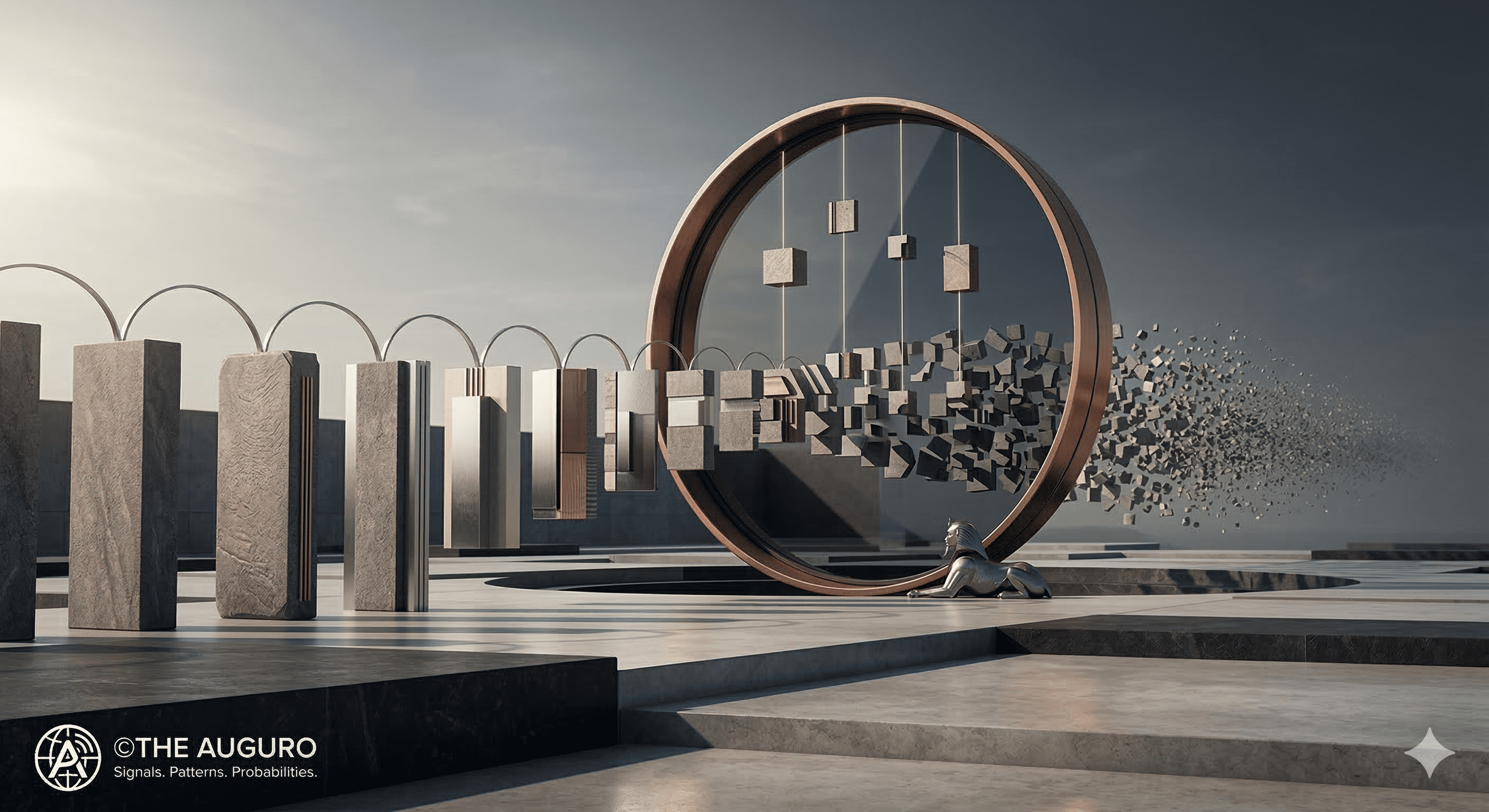
There is a moment in Joni Mitchell's Blue, roughly halfway through the record, where "Little Green" ends on a held piano note and "Carey" begins with the crack of a drum. The two songs are thematically unrelated — one an ache of maternal surrender, the other a sun-drunk Mediterranean ramble — and yet the juxtaposition produces something neither song can do alone. The contrast is the meaning. The album is the unit of sense.
I thought about that transition recently while watching a Spotify data visualization that a researcher had posted online. It showed, in cold aggregate, how listeners navigate the platform: 31 percent of streams come from algorithmically generated playlists, 23 percent from editorial playlists, and only 11 percent from listeners deliberately playing an album straight through. Those numbers have worsened steadily every year since 2018. By the time this piece is published, the album-as-listened-to is very likely in single-digit territory.
This is not a lament about modernity or a fantasy of return. It is an attempt to understand what exactly was destroyed, who destroyed it, and whether the thing that replaced it — the song-as-atomic-unit, the playlist-as-context — can bear the weight we once placed on albums.
The Album Was an Accident That Became an Argument
The long-playing record, introduced by Columbia in 1948, was initially a practical format. It held roughly 45 minutes of music across two sides, which made it suitable for classical compositions and Broadway cast recordings that had previously required multiple 78-rpm discs. Nobody in the late 1940s was thinking about artistic integrity. They were thinking about convenience.
What followed was one of the more remarkable cases of industrial constraint accidentally generating aesthetic ambition. Rock and pop artists of the 1960s discovered that the LP's structure — two sides, roughly equal duration, a natural pause at the halfway point — imposed a dramatic architecture. The Beatles began using albums as deliberate statements with Rubber Soul in 1965, and by 1967, with Sgt. Pepper's Lonely Hearts Club Band, the concept album was a dominant cultural form. The format taught artists to think in arcs, in contrasts, in narrative accumulation.
What the LP era produced, across its roughly four-decade dominance, was a canon of works in which sequencing was itself a compositional act. Marvin Gaye's What's Going On, Pink Floyd's The Wall, Kendrick Lamar's To Pimp a Butterfly — these are not collections of songs. They are arguments made through arrangement, through the management of tension and release, through the deliberate placement of silence and contrast. The album, at its best, was a container for ideas that no individual song could hold.
The Playlist Doesn't Care
Spotify launched in 2008, and within five years had fundamentally altered the incentive structure of recorded music. The company's business model — licensing catalogs and selling subscriptions — required maximum listener engagement. The tool they built to achieve that was the algorithm: a recommendation engine trained on billions of listening events, optimized for one thing above all else: that you do not press stop.
The algorithm does not skip your song. It skips your album. More precisely, it removes the album from the decision-making process entirely. When a listener follows a Spotify Radio station or the Daily Mix feature, they receive songs from across an artist's catalog, interspersed with similar artists, ordered by engagement probability. The lived experience of a listener on Spotify is not "I am listening to Lemonade." It is "I am listening to songs that the platform has determined I will like, delivered in an order optimized for my continued presence on the platform."
The consequences for artists were immediate and structural. A song placed in a major editorial playlist — Spotify's Rap Caviar, or Today's Top Hits — could generate tens of millions of streams in weeks. An album released without editorial support would struggle. The math was transparent: a song that got playlist placement generated more revenue than an album that got none. The incentive to write singles, not albums, became overwhelming.
Industry data confirms what any honest music professional will tell you. According to figures published by the Recording Industry Association of America, single-track digital sales and streams account for over 87 percent of recorded music consumption in 2025. The share of revenue coming from what the industry classifies as "album-equivalent consumption" — where a listener plays most of an album's tracks — has fallen from 41 percent in 2015 to approximately 18 percent today. On Kalshi, the prediction market, a contract asking whether any album released in 2026 will generate more than 500 million streams in its first month — the kind of sustained full-album engagement that once defined a blockbuster — has been trading at below 12 percent probability since its listing in January.
What the Algorithm Optimizes For (And What It Doesn't)
The Spotify algorithm is, in technical terms, a collaborative filtering system augmented by audio feature analysis. It knows that you listened to a particular song twice before skipping it. It knows that you played another song at midnight versus 8 a.m. It can infer, from acoustic properties, that a song is "energetic" or "melancholic." What it cannot know — what it is not designed to know — is why Blue is a masterpiece.
The distinction matters enormously. The algorithm optimizes for what researchers call "engagement signals": plays, saves, playlist additions, shares. These signals capture immediate gratification reasonably well. They are essentially useless for capturing the kind of experience that Blue offers, which is prolonged, sometimes uncomfortable, and requires submission to an artist's vision rather than accommodation of your preferences.
Put differently: the algorithm is excellent at giving you more of what you already like. It is systematically incapable of giving you something that will change what you like. Every breakthrough listening experience I can name from my own life — the first time I heard Ready to Die, or Hejira, or In Rainbows — involved a submission to an unfamiliar structure. The album format demanded that I follow it before it would reward me. The algorithm's entire design philosophy is the opposite of this.
Music scholars have a term for what the album enabled that the single cannot: "formal contrast." A slow, spare ballad placed after two frenetic rock songs does not just provide respite. It reframes both. The silence that follows In My Life on Rubber Soul is not empty; it is the space in which the song's meaning expands. This kind of meaning-through-structure is, by definition, lost when songs are extracted and resequenced by an algorithm.
The Artists Who Resisted, and What Happened to Them
It would be too simple to say that artists simply capitulated to the streaming economy. Some fought back, and the results were instructive.
Frank Ocean released Blonde in 2016 after a four-year absence, and he did so with deliberate opacity: no lead singles, no pre-release promotional rollout, no engagement with Spotify's editorial apparatus. The album appeared with virtually no warning on Apple Music exclusively, making a pointed statement about which platform was willing to treat the album as an artifact. Blonde was critically acclaimed and commercially successful, and it remains one of the most coherent artistic statements of the streaming era. It also represented, as Ocean must have known, an option available almost exclusively to artists who had already built an audience large enough to survive without algorithmic support.
Beyoncé has done something similar repeatedly. Lemonade, Renaissance, Cowboy Carter — each has been released with coordinated visual and narrative accompaniment that insists on the album as the unit of meaning. Each has been successful. But Beyoncé is, in the most literal sense, one of the most famous humans on earth. The strategies available to her are not transferable to emerging artists.
The artists who came up entirely within the streaming economy show the architectural consequences most clearly. Streaming-native pop — the genre that Spotify's algorithms most relentlessly reward — is characterized by short track lengths (the average hit song has gotten roughly 20 seconds shorter per decade since 2000), immediate hooks (first-chorus structures have largely replaced verse-chorus builds), and tonal consistency within a project rather than contrast. Artists like Doja Cat and Olivia Rodrigo are extraordinarily talented, but their albums, examined as formal objects, are assembled from units designed to function independently. They are not arguments. They are catalogs.
The Economics of Disappearance
The transformation of the music economy has had consequences beyond aesthetics. The album format, at its height, was an economic engine that supported significant investment in artists. Labels would sign acts for multiple albums, fronting the development costs on the assumption that album sales would eventually recoup. This multi-album development model produced careers: it gave artists the time and resources to develop over multiple projects, to fail and recover, to grow into their ambitions.
Streaming economics have largely destroyed this model. Revenue per stream on Spotify has been reported at approximately $0.003 to $0.005, meaning that a song needs roughly 300,000 streams just to generate $1,000 in gross royalties before the label's share is taken. An emerging artist releasing an album to a modest audience might generate 50,000 streams per track, total — roughly $150 to $250 in streaming revenue for a song that cost thousands of dollars to produce. The economics only work, at scale, for artists who have already succeeded.
Labels have responded rationally to these economics by reducing the number of artists they sign and concentrating resources on those most likely to generate immediate streaming engagement. The mid-tier artist — the one whose albums sold 200,000 copies in 1998, who would have had a sustained career of five or six albums — has largely disappeared. What remains is a bimodal distribution: superstars at one end and unsigned bedroom producers at the other, with relatively little in the middle.
What We Talk About When We Talk About the Algorithm
There is a version of this argument that is simply nostalgic, and I want to be careful not to make it. The album format was not inherently superior to what preceded or what may follow it. The technology that created it — the LP — also created conditions that were restrictive in ways we tend to forget. Albums cost significant money to produce and purchase. They were physically immobile, requiring ownership of playback equipment. They were gatekept by record labels that exercised enormous power over which artists were heard at all.
Streaming has democratized access in ways that are genuinely significant. Any person with a smartphone can now hear virtually any recorded music in history. Artists can release work directly to audiences without label intermediation. The Spotify algorithm, whatever its limitations, has genuinely introduced listeners to music they would not otherwise have found.
But democratization of access and the death of meaningful form can coexist, and I think that is largely what has happened. We can now hear anything, but the platform through which we hear it has systematically degraded the conditions under which music can mean something beyond immediate pleasure.
The music critic Ted Gioia, writing in 2023, described what he called the "dopamine-driven playlist economy": an environment in which music's primary function has shifted from meaning to mood management. He documented the explosive growth of ambient and lo-fi study music, of sleep-optimization playlists, of genre categories built entirely around emotional utility rather than artistic identity. He was not wrong. The most-streamed category on Spotify in 2025, by total listening hours, is not hip-hop or pop or classical. It is something the platform calls "focus," a genre that didn't exist as a category fifteen years ago.
The Question That Remains
Whether the album can be revived as a serious formal structure is genuinely unclear. There are artists — Kendrick Lamar with GNX in 2024, Charli XCX with Brat — who continue to make albums that function as coherent arguments, where the sequencing matters, where the internal contrasts produce meaning that no individual track can generate. There is an audience for this, and it appears to be growing in cultural influence even as it shrinks as a percentage of total consumption.
The prediction markets reflect this ambiguity. On Kalshi, a contract asking whether a streaming platform will introduce an "album mode" feature — one that prevents skip behavior and presents albums sequentially as a distinct listening option — has traded above 34 percent probability for the past three months. Whether that would actually change listening behavior, or merely create a feature that most users ignore, is another question entirely.
What is not ambiguous is the cost of what has been lost. The album at its best was one of the distinctive art forms of the twentieth century: a medium that required artists to think at the scale of a complete argument and required listeners to follow that argument to its conclusion. The platform that replaced it was designed with different goals, and it has achieved them. Whether the goals were worth the sacrifice is a question the algorithm cannot help you answer.
I return, sometimes, to that transition on Blue: the held note, the silence, the crack of drum. Mitchell did not sequence the album that way because a platform told her it would increase engagement. She did it because the contrast meant something — because "Carey's" joy lands differently after "Little Green's" grief, because the album is a space in which meanings accumulate and transform each other. To hear it the way she intended, you have to submit to the sequence. You have to stop choosing. That kind of submission — which is another word for trust — is precisely what the streaming economy was designed to make unnecessary. And in doing so, it made it impossible.